
Tämä on kertomus yhdestä kuvauspäivästä, jolloin sain seurata lintujen elämää keskellä korpisoita, paikassa, jossa ihmisen läsnäolo on vain ohikiitävä sivujuonne. Päivä alkoi käytännössä yöllä. Herätyskello soi pimeän vielä painaessa maisemaa, ja pian lastasin kuvauskaluston ja eväät autoon. Edessä oli tunti ajoa kurssikaverin luo, ja siitä vielä tunti lisää kohti määränpäätä.
Auton jätimme syrjään metsätien päähän. Siitä eteenpäin matka jatkui jalan. Kotkakojuille oli vain muutama sata metriä, mutta ne kuljettiin sysipimeässä, otsalamppujen kapeassa valokeilassa. Polku kiemurteli lumisen suon halki. Pintavesi oli jäässä, mutta jää petti vähän väliä, ja kumisaapas humahti ohuen pinnan läpi kylmään veteen. Kulku oli varovaista ja hidasta, juuri sellaista, jossa aika tuntuu pysähtyvän.
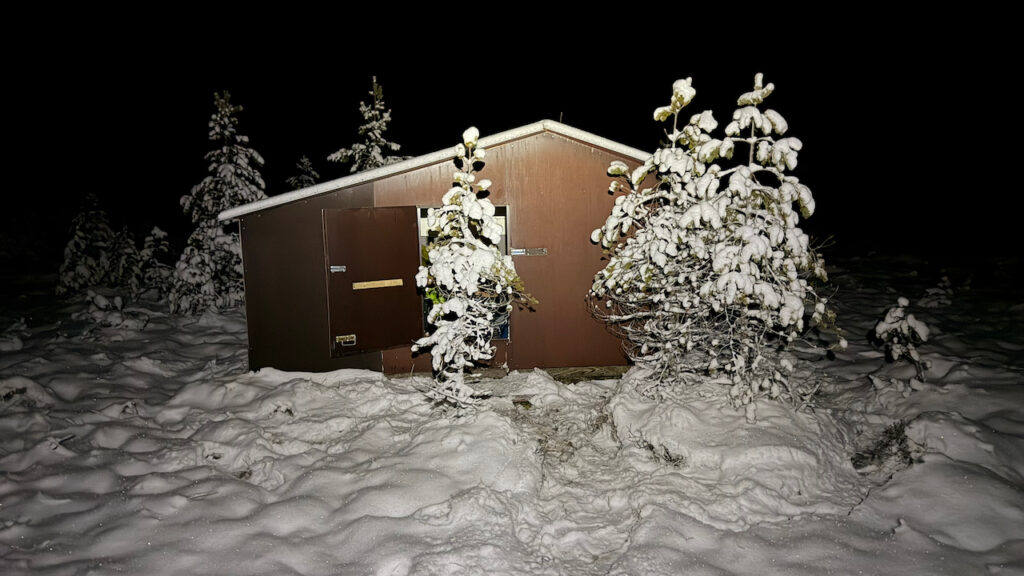
Otsalamppujen valossa hahmottui lopulta matalia rakennelmia keskellä suota. Kojut. Hetken asettumisen jälkeen kaverini käynnisti kaasulämmityksen, ja pian kylmä hiipi ulos sormista. Asettelimme kamerat valmiiksi: objektiivit kankaan läpi, rungot tukevasti videojalustoille. Ulkona oli yhä pilkkopimeää, joten ei auttanut kuin odottaa.
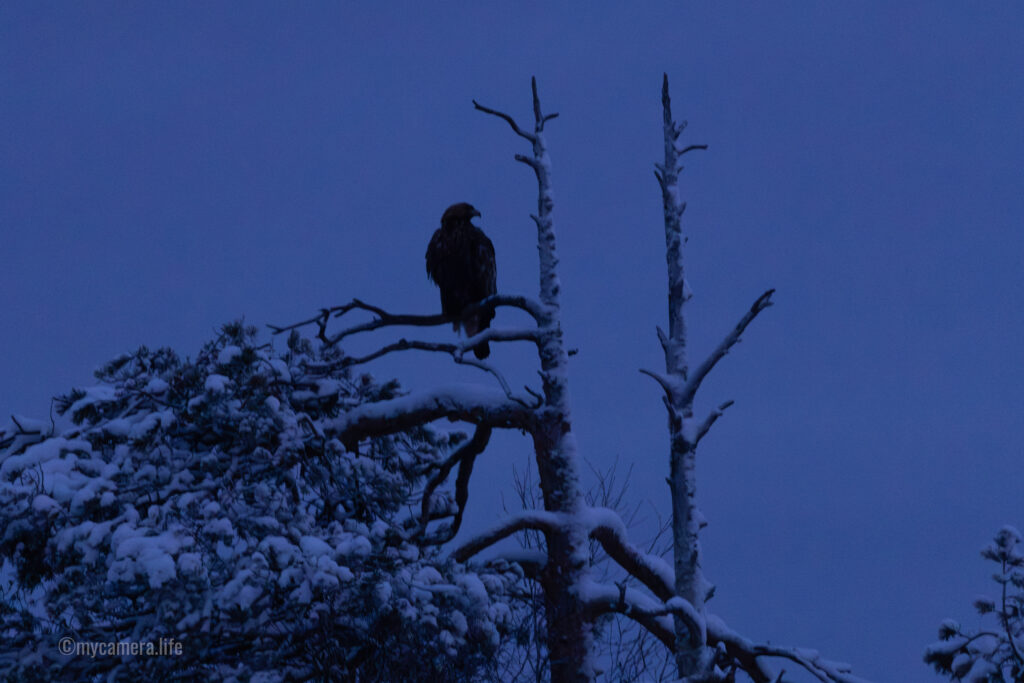
Reilun tunnin kuluttua maisema alkoi erottua kameran etsimen kautta. Suljinaikaa pidentämällä näkymä avautui kuin valonvahvistinkiikareilla. Sinertävä hämärä paljasti suon, puut ja tyhjältä näyttävän näyttämön. Emme ehtineet kauaa katsella, kun korkealle puun latvaan ilmestyi tumma hahmo. Se oli saapunut lähes huomaamatta, äänettömästi kuin aave. Päivän ensimmäinen kotka. Hämärässä ei vielä voinut sanoa, oliko kyseessä meri- vai maakotka, molempia alueella tiedettiin liikkuvan.
Aamun sarastaessa valo vahvistui vähitellen. Sininen hetki muuttui harmaammaksi, mutta aurinko pysyi visusti pilviverhon takana. Edessämme kaksi kotkaa ja useampi korppi aloittivat ruokailun jäätyneessä maassa olevan saaliin äärellä. Ennen kojuun tuloa kaverini oli käynyt rikkomassa jäätynyttä sianruhoa, jotta linnut saisivat siitä helpommin irti palasia. Se oli karua, mutta luonnon kannalta välttämätöntä realismia.
Päivän aikana alueella kävi yhteensä viisi kotkaa ja toistakymmentä korppia. Välillä joukkoon ilmestyi myös pikkulintuja, tiaisia, jotka nokkivat rohkeasti jäätyneiden ruhojen reunoilta. Korpit härnäsivät kotkia jatkuvasti ja uskaltautuivat jopa nyppimään pyrstösulkia. Kotka vastasi levittämällä valtavat siipensä ja hypähtämällä kohti häiritsijöitä. Se riitti. Korpit perääntyivät nopeasti, mutta vain hetkeksi – pian pieni kinastelu alkoi taas alusta. Lopulta kaikki saivat syödyksi. Linnut vaihtoivat vuoroa, ja odottaessaan sopivaa hetkeä ne istuivat pitkiä aikoja puiden oksilla. Korpit olivat levottomia ja äänekkäitä, kotka taas saattoi istua paikallaan puolikin tuntia viimassa, ympäristöä herkeämättä tarkkaillen.
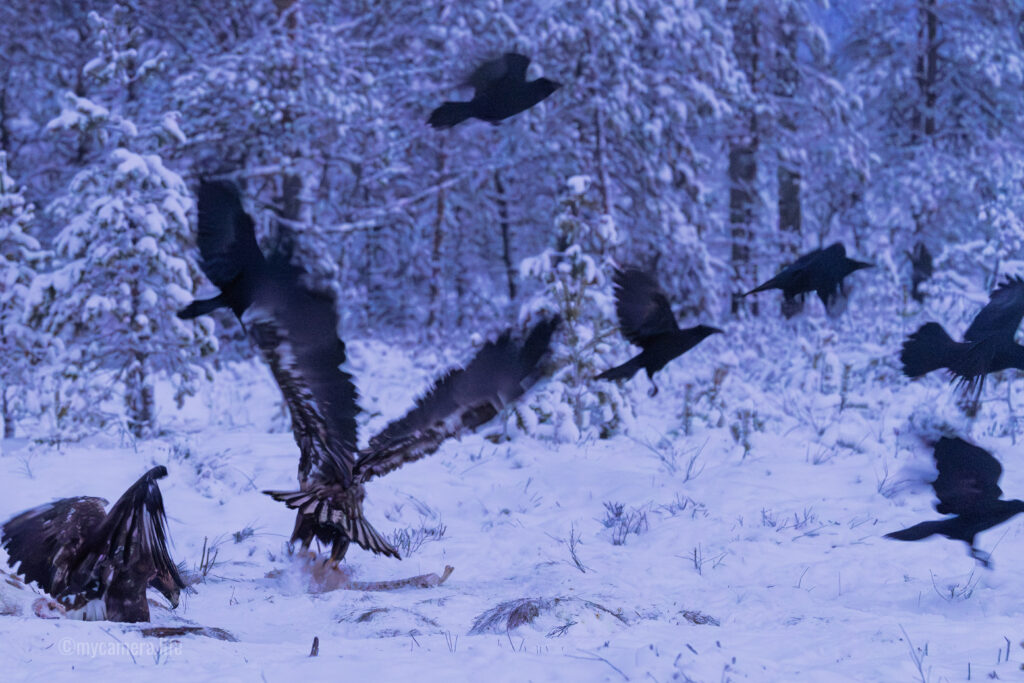
Kuvaaminen oli ajoittain haastavaa. Valo ei koskaan kunnolla voimistunut, ja pilviverho piti maiseman tasaisen harmaana koko päivän. Suljinnopeus oli pakko pitää alhaisena, jotta kuvat eivät jäisi liian tummiksi. Vastapainona nopea liike muuttui helposti sumeaksi, ja hämärä toi mukanaan kohinaa. Automaattisilla asetuksilla olisi toki voinut kuvata, mutta paras kuvanlaatu syntyy silloin, kun kameraa ohjaa itse. Säädin valotusta manuaalisesti, käyttäen useita painikkeita ja säätimiä tilanteen mukaan. Peilittömän kameran etuna on myös täydellinen äänettömyys: elektroninen suljin ei paljasta kuvaajaa lainkaan.
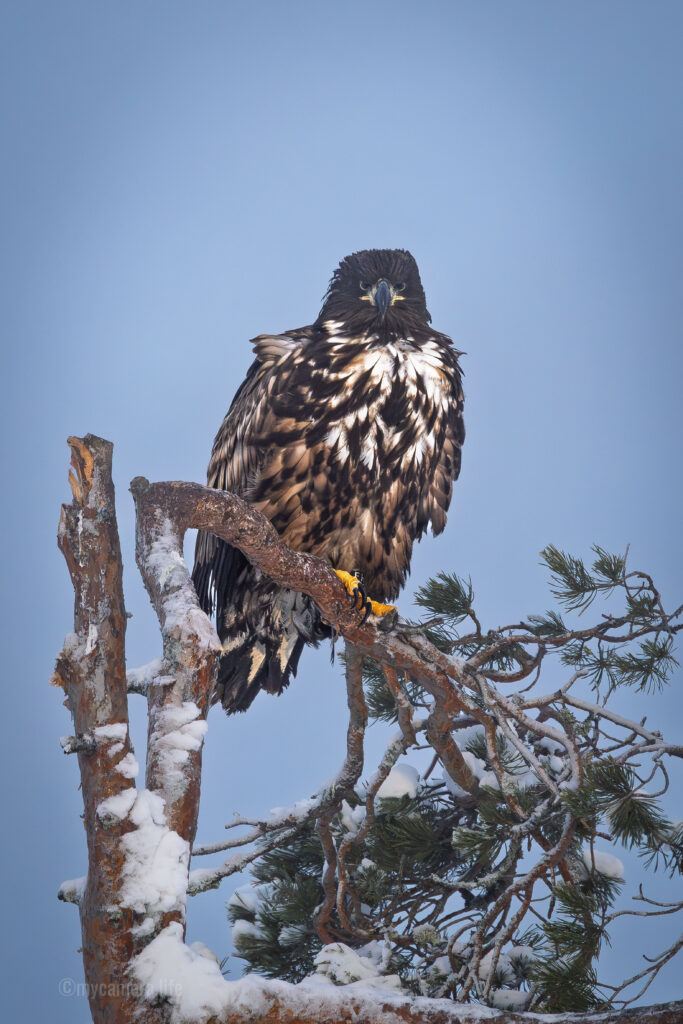
Still-kuvien lisäksi harjoittelin videokuvausta. Sain talteen useita minuutteja erilaista toimintaa etualalla. Luontovideo ei ole minulle vielä tuttua aluetta, joten materiaali on ennen kaikkea harjoitusta varten. Valokuvia kertyi kuitenkin runsaasti muistikorteille, ja niiden läpikäynti ja käsittely vie vielä aikaa.
Kojukuvaamisesta opin jälleen paljon, vaikka kokemusta oli ennestäänkin. Tulevia kuvausreissuja varten tiedän nyt paremmin, miten säätää kameran nopeasti muuttuviin tilanteisiin ja miten varustautua oikein. Kaiken kaikkiaan päivä oli poikkeuksellisen antoisa, sellainen, joka muistuttaa, miksi näihin paikkoihin ylipäätään vaivautuu lähtemään.
In english
Where the Eagles Fly
This is a story of one photography day when I had the chance to observe birdlife in the middle of remote wilderness bogs, a place where human presence is only a brief and insignificant detail. The day began, for all practical purposes, at night. The alarm went off while darkness still ruled the landscape, and soon I loaded my camera gear and food into the car. First came an hour’s drive to pick up a course mate, followed by another two hours toward our destination.
We left the car at the end of a forest road. From there, the journey continued on foot. The distance to the eagle hides was only a few hundred meters, but it had to be walked in complete darkness, guided only by the narrow beams of our headlamps. The path wound across a snow-covered bog. The surface water was frozen, but the ice gave way from time to time, and a rubber boot broke through the thin crust into icy water. Progress was careful and slow, the kind where time seems to stand still.
In the light of our headlamps, low structures finally emerged in the middle of the bog. The hides. After settling in, my companion turned on the gas heater, and before long the cold retreated from our fingers. We set up the cameras: lenses through the fabric openings, camera bodies firmly mounted on video tripods. Outside, it was still pitch dark, so there was nothing to do but wait.
After more than an hour, the landscape began to appear through the camera viewfinder. By extending the shutter speed, the scene opened up like through night-vision binoculars. The bluish twilight revealed the bog, the trees, and what looked like an empty stage. We had not been watching for long when a dark shape appeared high in the top of a tree. It had arrived almost unnoticed, silently, like a ghost. The first eagle of the day. In the dim light it was impossible to tell whether it was a White-tailed Eagle or a Golden Eagle — both were known to inhabit the area.
As morning approached, the light slowly grew stronger. The blue moment faded into grey, while the sun remained hidden behind a thick cloud cover. In front of us, two eagles and several ravens began feeding on a carcass lying frozen on the ground. Before entering the hide, my companion had broken open the frozen pig carcass so the birds could more easily tear off smaller pieces. It was harsh, but a necessary realism of nature.
Over the course of the day, a total of five eagles and more than ten ravens visited the site. Occasionally, small birds — tits — also appeared, boldly pecking at the edges of the frozen remains. The ravens constantly harassed the eagles and even dared to nip at their tail feathers. The eagle responded by spreading its massive wings and jumping slightly toward the intruders. That was enough. The ravens retreated quickly, but only for a moment; the bickering began again. In the end, all the birds managed to feed. They took turns at the carcass, and while waiting for an opportunity, both ravens and eagles spent long periods perched in trees. The ravens were restless and noisy, while an eagle could sit motionless for half an hour in the wind, scanning the surroundings with steady focus.
Photography was challenging at times. The light never truly improved, as the cloud cover kept the scene evenly grey throughout the day. The shutter speed had to remain low to avoid underexposed images. As a result, fast movement easily turned into blur, and the dim conditions introduced noise. Automatic settings would have worked, but the best image quality comes from controlling the camera manually. I adjusted exposure myself, using several buttons and dials depending on the situation. One advantage of modern mirrorless cameras is complete silence — the electronic shutter gives away nothing.
In addition to still images, I also practiced video recording. I captured several minutes of different events unfolding in the foreground. Nature video is not yet familiar territory for me, so this material is mainly for experimentation. Still photographs, however, filled the memory cards, and selecting and processing them will take time.
I once again learned a great deal about working in a hide, even though I had done it before. For future trips, I now know better how to adjust the camera for changing situations and how to prepare properly. All in all, it was a gratifying day, one that reminds you why you make the effort to come to places like this in the first place.