Lue tämä postaus suomeksi:
One day, an advertisement for Osprey Oasis (Sääksikeidas) popped up in my social media feed. It could easily have been lost among all the other posts, but one detail immediately caught my attention: the location was Tervo, just 130 kilometres from my home. My curiosity was instantly sparked. I had never actually looked for places to photograph ospreys because I had always assumed that the best opportunities were mainly in southern Finland. Discovering a dedicated osprey photography site this close to home was therefore a pleasant surprise, and I headed straight to the Osprey Oasis website to find out more.
The website introduced the photography hides, different shooting angles and the small pond where the action takes place. The pond is stocked with live fish, but the fish are certainly not simply handed to the ospreys. The birds have to do what they would do in the wild: spot their prey, dive into the water, grab the fish with their powerful talons and lift themselves back into the air. That was enough to convince me, so I booked one of the hides recommended for first-time visitors and paid immediately. A confirmation email arrived shortly afterwards, and then everyday life took over again. A few days before the scheduled shoot, however, my phone rang. It was Kimmo Pörri, the owner of Osprey Oasis, calling to confirm my arrival and give me some initial instructions for the evening.
We met as agreed when I arrived, and before heading out to the photography site, we had time to chat about ospreys, wildlife photography and, somewhat unexpectedly, regional politics. We then drove in convoy to the actual oasis, which is located on private land belonging to a local fish farm. The location is almost perfect for the purpose. The short distance means that the photography pond can be supplied with fresh fish directly from the nearby fish farm. The pond itself is small and shallow, separated from the adjacent lake by only a narrow strip of land, and fresh water is continuously pumped into it to provide good conditions for the fish. The ospreys benefit from the arrangement as well, with a plentiful supply of food, although there is nothing artificial about the way they get it. The birds still have to hunt, spot the fish, make their spectacular dive, plunge into the water, grab their prey with their sharp talons and lift themselves back into the air.
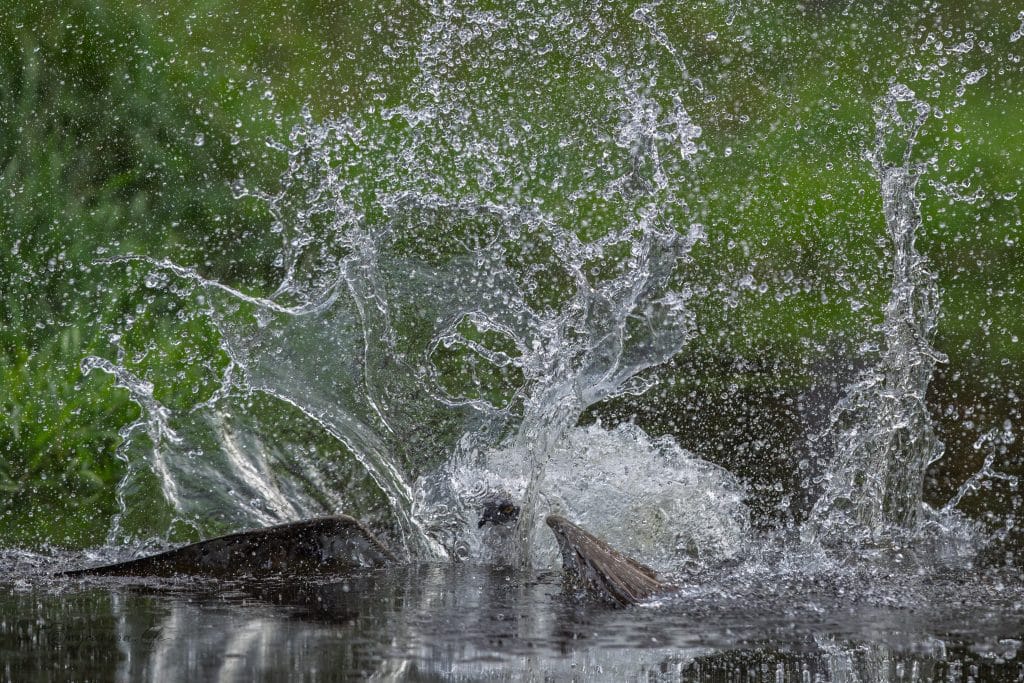
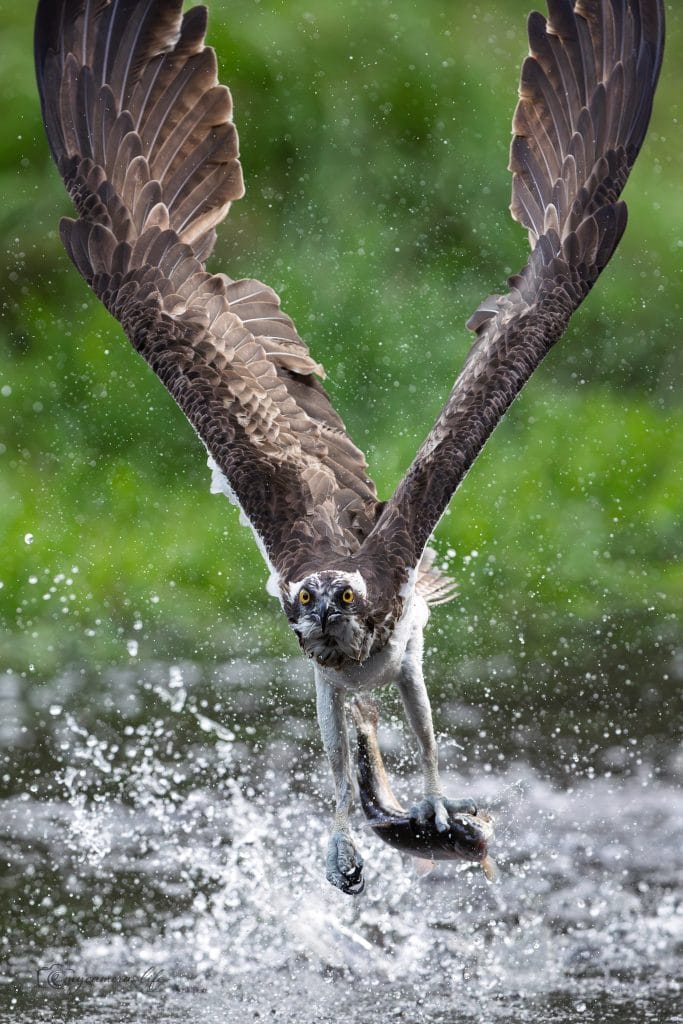
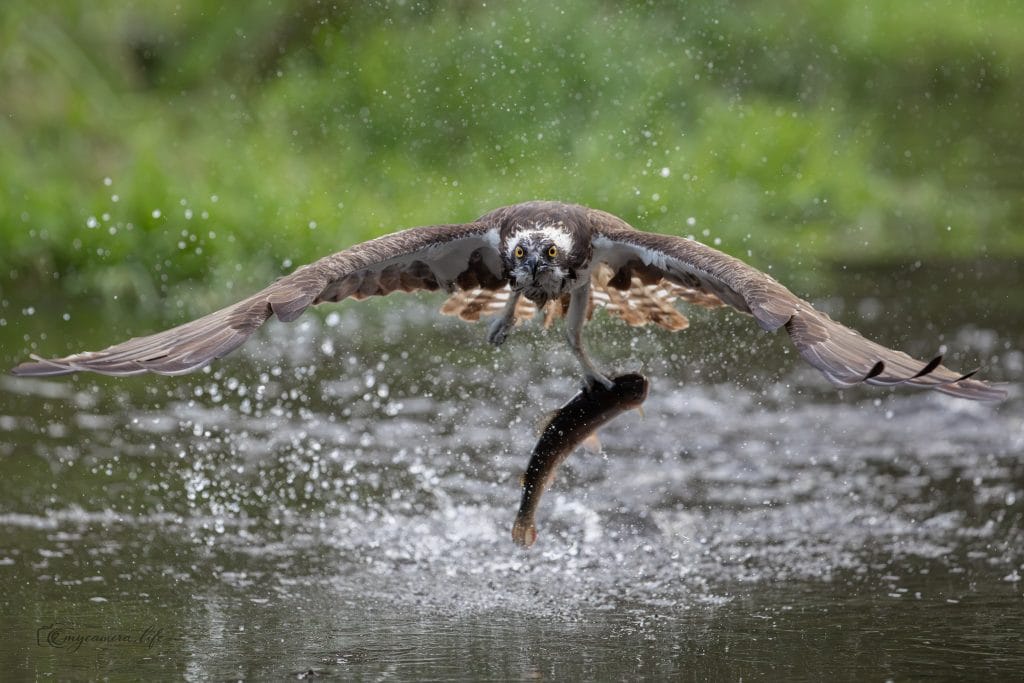
This is where the magic of osprey photography really begins. Everything happens in fractions of a second. A bird may be circling high above the pond when suddenly its attention locks onto a fish below. In an instant, its wings change position, the dive begins, and the bird accelerates towards the water like a missile. The talons hit the surface, the fish is caught, and the osprey bursts back into the air through a cloud of spray. There is no posing for the photographer, and the entire sequence can be over almost before you have time to process what you have seen. You have to be ready before the action begins because once the osprey commits to the dive, there is no time to make adjustments.
With Kimmo’s guidance, I settled into my hide. Another photographer was in the neighbouring hide, so there were two of us on the evening shift. I mounted my gimbal head directly onto the sturdy mounting plate in the hide and attached my camera with a 300mm f/2.8 lens. The fast lens was going to be important as the evening progressed and the light gradually began to fade. Freezing a diving osprey and the spray exploding around it requires a very fast shutter speed, typically somewhere around 1/4000 to 1/6000 of a second. Slower speeds can work, but the risk of motion blur increases quickly. My goal for the evening was therefore quite simple: I wanted pure action and as much drama as possible. I particularly like images where the subject is razor sharp against a beautifully blurred background. Wider environmental images have their place too, and a smaller aperture can be used to bring more of the surroundings into focus, but this time I was not looking for a landscape with an osprey in it. I wanted the bird, the fish, the water and the action to tell the whole story.
My shift started at 3 p.m., but I had to wait for more than three hours before I saw the first dive. The hide was warm, the sun was shining, and the long wait inevitably began to take its toll. Every now and then my concentration wandered, and my eyelids grew heavy. Osprey photography is, in many ways, a test of patience because nothing may happen for hours, yet the next moment can unfold without warning and be over in less than a second. I was beginning to drift into a light doze when a dark shape suddenly appeared in the corner of my eye, and my attention snapped back instantly. Over the following period, two ospreys made several dives, although not every attempt was ideal from a photographer’s point of view. A couple of dives happened directly behind the hide or almost overhead, leaving me with little more than the rush of wings, a shower of water droplets in the foreground and the vivid memory of something incredibly fast having just happened.
The approaches from the front were much easier to photograph. When an osprey was sitting in its favourite tree or circling above the pond, I could follow its movements and anticipate the beginning of a dive. My eyes stayed locked on the bird, my finger rested on the shutter button and the camera was ready. Even then, using a fixed 300mm lens at such close range required considerable precision. The field of view is tight, and keeping a rapidly moving bird completely inside the frame requires good anticipation, fast reactions and, occasionally, a little luck. An osprey can suddenly enter exactly the right part of the frame, only to move a few metres closer and destroy the composition in the blink of an eye. That is why the camera settings need to be right before the first dive. I set the continuous shooting speed to its maximum, which on my camera is 30 frames per second. With the autofocus properly configured for tracking birds, it can follow the osprey surprisingly well even during a high-speed dive, although no autofocus system is perfect and there will always be plenty of missed frames.
When everything comes together, the focus, composition, wing position, visible fish and exploding water droplets, a single successful frame can make the entire wait worthwhile. That is perhaps the essence of osprey photography. You can spend hours waiting for just a few seconds of action, knowing that when those seconds finally arrive, everything has to happen at exactly the right moment. The reward is not simply a sharp photograph, but the feeling of having managed to capture something that existed for only an instant. When the image you have been hoping for finally appears on the memory card, the long wait suddenly makes perfect sense.
Tervo’s Osprey Oasis is undoubtedly a destination worth visiting for any wildlife photographer. The activity at the pond can be followed beforehand through the Sääksikeidas live stream on YouTube and its chat, which gives you a useful idea of how active the birds are before making the trip. The site is also easy to reach by car thanks to good road connections, and the combination of knowledgeable guidance, well-designed photography hides and, most importantly, the opportunity to photograph an osprey displaying its natural hunting behaviour makes Osprey Oasis a place that is very easy to fall in love with.
My first evening eventually came to an end, and I closed the door of the hide, packed the camera gear back into the car and headed home with a memory card full of successes, misses and several moments that had happened far too quickly to capture properly. After waiting for more than three hours for the first real action, I knew that the experience had been worth every minute. More importantly, I knew that this would not be my last visit to Osprey Oasis.