
Sain jälleen mahdollisuuden viettää päivän kotkakojulla. Tämä ei ole enää sattumaa, vaan pieni etuoikeus: eräs valokuvauskurssilaisistani on kojun ylläpitäjiä ja on kutsunut minut sinne nyt jo kolmannen kerran. Kojupäivä on muodostunut rituaaliksi, jossa aikataulun ja tekemisen sanelevat täysin linnut — ja tässä tapauksessa ennen kaikkea kotkat.
Kojulle ei mennä silloin kun näkee. Sinne mennään silloin kun ei näe mitään.
Saavuimme paikalle pilkkopimeässä, hyvissä ajoin ennen ensimmäistäkään siiveniskua ruokinnalla. Tällä kertaa maisemaa valaisi kalpea kuu, ja sammutimme otsalamput jo polun alkupäässä. Kävelimme loppumatkan ilman keinovaloa, hiljaa, omilla silmillä suunnistaen. Pakkasta oli reilusti yli kaksikymmentä astetta, mutta onneksi matka jalan ei ollut pitkä. Sellaisessa kylmyydessä huomaa nopeasti, kuinka turhaa puhuminen on. Kaikki energia menee hengittämiseen ja liikkumiseen.
Kun varusteet oli kannettu sisään, videopäät aseteltu ja kamerat saatu toimintavalmiiksi, alkoi se osuus päivästä, jota kukaan ei koskaan näe valmiista kuvista: odottaminen.
Koju on hyvin varusteltu, ja kaasulämmitin alkoi pitää sisäilman siedettävänä. Välillä sai jopa oikaista kojun sängyille ja antaa kehon levätä, vaikka mieli pysyikin koko ajan ulkona. Ensimmäiset vieraat saapuivat hämärässä: korpit. Ne ovat aina paikalla ensimmäisenä, kuin varmistamassa, että näytös voi alkaa. Ensimmäinen kotka ilmestyi puuhun kahdeksan aikaan, juuri kun aamuaurinko alkoi hivuttaa valoa maisemaan.
Tällä kertaa päivä ei ollut tapahtumarikas. Todennäköisesti kireä pakkanen hillitsi lintujen aktiivisuutta. Aiemmilta kerroilta tuttu ilmassa tapahtuva akrobatia ja keskinäinen mittelöinti puuttuivat lähes kokonaan. Havaitsimme kaksi muuta kotkaa kauempana puiden latvoissa. Kaikki kolme istuivat pitkään paikoillaan, liikkumatta juuri lainkaan. Ne näyttivät yksinkertaisesti nauttivan auringon lämmöstä, selkä valoa vasten.
Ensimmäinen kotka laskeutui syömään vasta puolen päivän aikaan.
Sekään ei tapahtunut suoraan. Ensin lyhyt lento läheiseen puuhun siihen aiemmin tulleen viereen. Siellä tarkka, lähes liikkumaton tähystys. Vasta kun alue oli varmasti turvallinen, se laskeutui alas. Olen oppinut tunnistamaan tämän käyttäytymisen: kotka ei tee mitään kiireellä. Jokainen liike on harkittu. Jokainen suupala keskeytyy hetkeksi, kun katse kiertää horisontin läpi. Se ei ole hermostuneisuutta. Se on äärimmäistä tietoisuutta ympäristöstä.
Iltapäivän aikana tilanteita tuli muutamia. Kotka oksalla. Kotka syömässä. Kotka tarkkailemassa.
Nämä ovat kuvia, joita saa paljon. Ne ovat hyviä lajikuvia. Dokumentaarisesti arvokkaita. Mutta jos olen rehellinen, ne eivät ole niitä kuvia, joiden vuoksi minä istun kojussa tuntikausia.
Ne kuvat, joita odotan, ovat sekunnin mittaisia.
Ne hetket, kun kaksi kotkaa päättää, että nyt ei enää väistetä. Kun lumi pöllyää, siivet levittyvät täyteen mittaansa ja tilanne muuttuu sekunnissa hallitusta kaaokseksi. Silloin syntyy kuvia, joissa kotkan luonne näkyy. Ei enää harkittuja liikkeitä vaan pelkkää vaistomaista reaktiota. Silloin kamera ei saa olla pois päältä, vaan valmiina, sormi puolivälissä laukaisinta. Kamera ottaa jo kuvia, vaikka ei tallennakaan niitä muistikortille. Pre-capture tallentaa useita kuvia myös taaksepäin ajassa – kun painan laukaisimen pohjaan, saan sekä hetkeä edeltävät kuvat että 30-40 kuvaa sekunnissa eteenpäin. Filmikamera-aikoina tällaisesta ei osannut edes haaveilla.
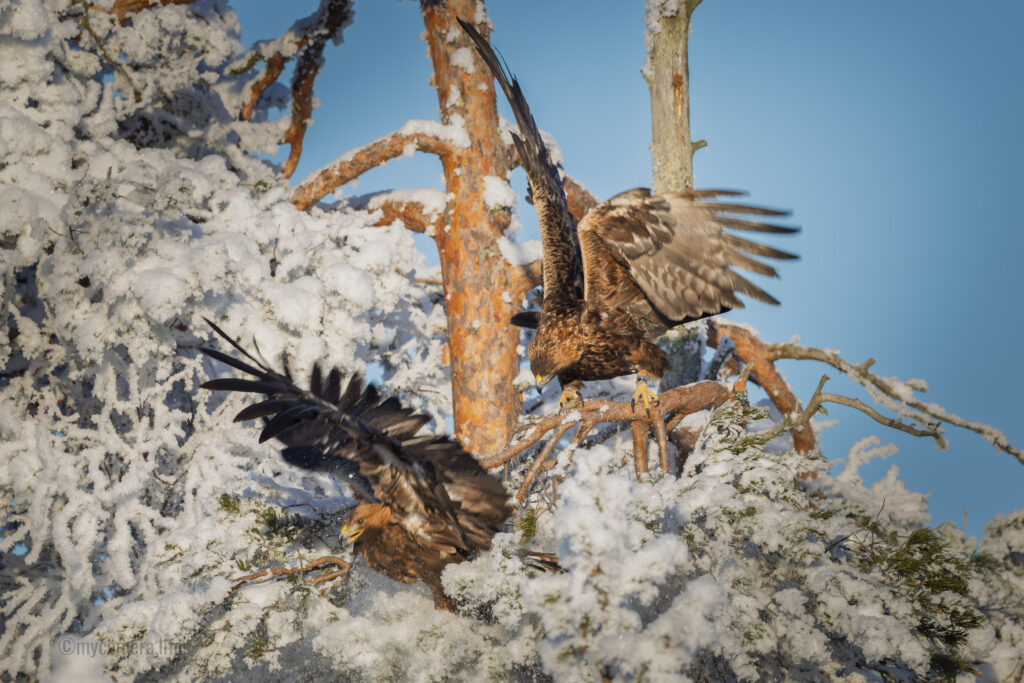
Ja niitä hetkiä on päivän aikana ehkä minuutti. Kaksi, jos onni potkaisee.
Loppupäivä on odottamista sitä yhtä minuuttia varten.
Voisi sanoa, että kotkakojulla kuvauspäivä kestää tuntikausia, mutta varsinainen kuvaaminen kestää vain hetken. Juuri se tekee siitä niin koukuttavaa.
In English
I was given the opportunity once again to spend a day in an eagle hide. This is no longer by chance, but rather a small privilege: one of my photography course participants is among those who maintain the hide and has now invited me there for the third time. The hide day has become a ritual where the schedule and activity are dictated entirely by the birds—and in this case, above all, by the eagles.
You don’t go to the hide when you can see. You go when you can’t see anything.
We arrived in pitch darkness, well before the first wingbeat at the feeding site. This time a pale moon lit the landscape, and we switched off our headtorches at the start of the path. We walked the rest of the way without artificial light, quietly, navigating by our own eyes. The temperature was well over twenty degrees below zero, but fortunately, the walk wasn’t long. In that kind of cold you quickly realise how pointless talking is. All your energy goes into breathing and moving.
Once the equipment had been carried inside, tripod heads positioned and cameras made ready, that part of the day began which no one ever sees in the finished images: waiting.
The hide is well equipped, and the gas heater soon kept the interior air bearable. At times, one could even stretch out on the hide’s beds and let the body rest, though the mind remained outside the whole time. The first visitors arrived in the dim light: ravens. They’re always there first, as if confirming that the performance can begin. The first eagle appeared in a tree around eight o’clock, just as the morning sun began to edge light into the landscape.
This time the day wasn’t eventful. The bitter cold likely dampened the birds’ activity. The aerial acrobatics and mutual sparring familiar from previous visits were almost entirely absent. We spotted two other eagles further away in the treetops. All three sat motionless for long periods, barely moving at all. They simply appeared to be enjoying the sun’s warmth, feathers spread wide against the light.
The first eagle descended to feed only around midday.
Even that didn’t happen directly. First a short flight to a nearby tree next to one that had arrived earlier. There, a precise, almost motionless surveillance. Only when the area was certainly safe did it descend. I’ve learnt to recognise this behaviour: an eagle does nothing in haste. Every movement is deliberate. Each mouthful is interrupted momentarily as the gaze sweeps across the horizon. It’s not nervousness. It’s extreme awareness of the surroundings.
During the afternoon a few situations arose. Eagle on a branch. Eagle feeding. Eagle watching.
These are images you get plenty of. They’re good species shots. Documentarily valuable. But if I’m honest, they’re not the images for which I sit in a hide for hours.
The images I’m waiting for last a second.
Those moments when two eagles decide that now there’ll be no more yielding. When snow billows up, wings spread to their full span and the situation turns from controlled to chaotic in a second. That’s when images emerge where the eagle’s nature shows. No more deliberate movements, just pure instinctive reaction. Then the camera mustn’t be switched off, but ready, finger halfway on the shutter. The camera is already taking images even though it’s not saving them to the memory card. Pre-capture saves several images backwards in time—when I press the shutter fully, I get both the images preceding the moment and 30-40 frames per second going forward. In the film camera days one couldn’t even dream of such a thing.
And those moments last perhaps a minute during the day. Two, if luck strikes.
The rest of the day is waiting for that one minute.
One could say that at an eagle hide the photography day lasts for hours, but the actual photographing lasts only a moment. That’s precisely what makes it so addictive.